

El Almudín
El Almudín is one of Valencia’s oldest historic buildings and an important example of the city’s medieval heritage. Originally built as a grain storage and trading centre, it later became a cultural and exhibition space. Its impressive interior, historic arches and colourful wall paintings make it an interesting place to visit in Valencia’s old town.
El Almudín is one of the most historic buildings in Valencia and an important part of the city’s architectural heritage. The building dates back to the beginning of the 14th century and was constructed on the site of a former Muslim fortress. Its original purpose was to store, protect and distribute wheat, which was an essential product for the population of medieval Valencia.
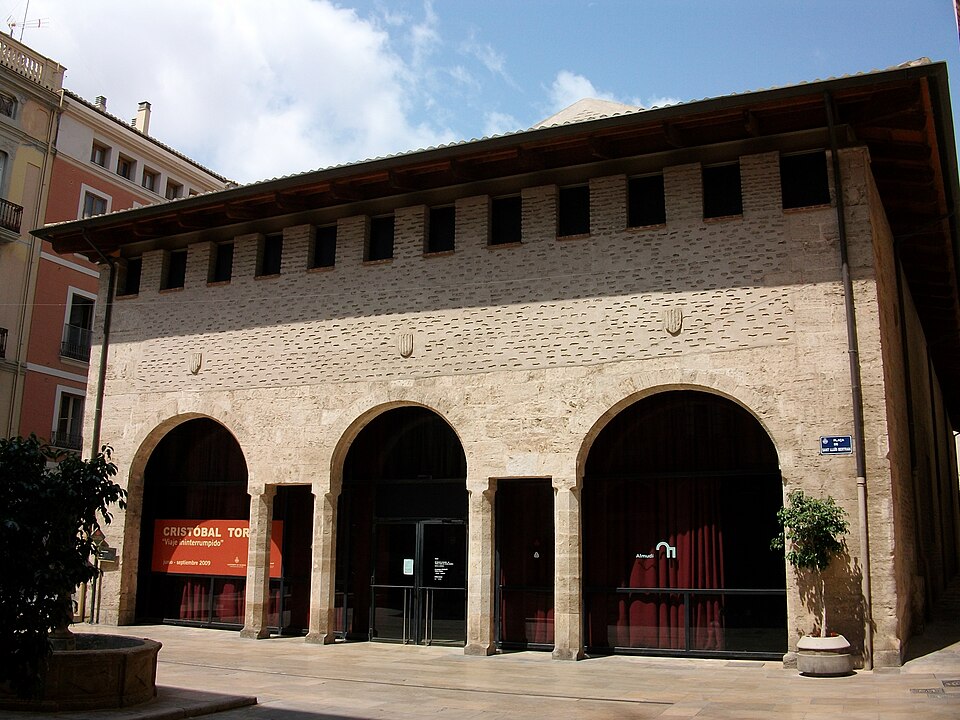
As the city grew, the building was expanded during the 15th and 16th centuries. One of its most distinctive features is the large entrance porch added during the first half of the 16th century, together with the coats of arms of the city and its impressive semicircular-arched entrance.
Inside, visitors can admire historic wall paintings depicting the arrival of wheat into Valencia and the patron saints of the guilds involved in the grain trade. These paintings provide a fascinating insight into the economic and social life of the city in the past.
Over the centuries, El Almudín has had different functions. From 1904 to 1989, it housed Valencia’s Paleontological Museum. Today, the building is mainly used as an exhibition and cultural space and occasionally hosts artistic and musical events.
Located in the historic centre, close to Valencia Cathedral and other important landmarks, El Almudín is an excellent stop for visitors interested in history, architecture and culture. Its combination of medieval origins, historic paintings and cultural activities makes it a unique place to discover a lesser-known side of Valencia.
El Almudín is one of the most historic buildings in Valencia and an important part of the city’s architectural heritage. The building dates back to the beginning of the 14th century and was constructed on the site of a former Muslim fortress. Its original purpose was to store, protect and distribute wheat, which was an essential product for the population of medieval Valencia.
As the city grew, the building was expanded during the 15th and 16th centuries. One of its most distinctive features is the large entrance porch added during the first half of the 16th century, together with the coats of arms of the city and its impressive semicircular-arched entrance.
Inside, visitors can admire historic wall paintings depicting the arrival of wheat into Valencia and the patron saints of the guilds involved in the grain trade. These paintings provide a fascinating insight into the economic and social life of the city in the past.
Over the centuries, El Almudín has had different functions. From 1904 to 1989, it housed Valencia’s Paleontological Museum. Today, the building is mainly used as an exhibition and cultural space and occasionally hosts artistic and musical events.
Located in the historic centre, close to Valencia Cathedral and other important landmarks, El Almudín is an excellent stop for visitors interested in history, architecture and culture. Its combination of medieval origins, historic paintings and cultural activities makes it a unique place to discover a lesser-known side of Valencia.
DETAILS
Tuesday to Saturday, 10:00 AM–2:00 PM and 3:00 PM–7:00 PM. Sundays and public holidays, 10:00 AM–2:00 PM. Closed on Mondays.